






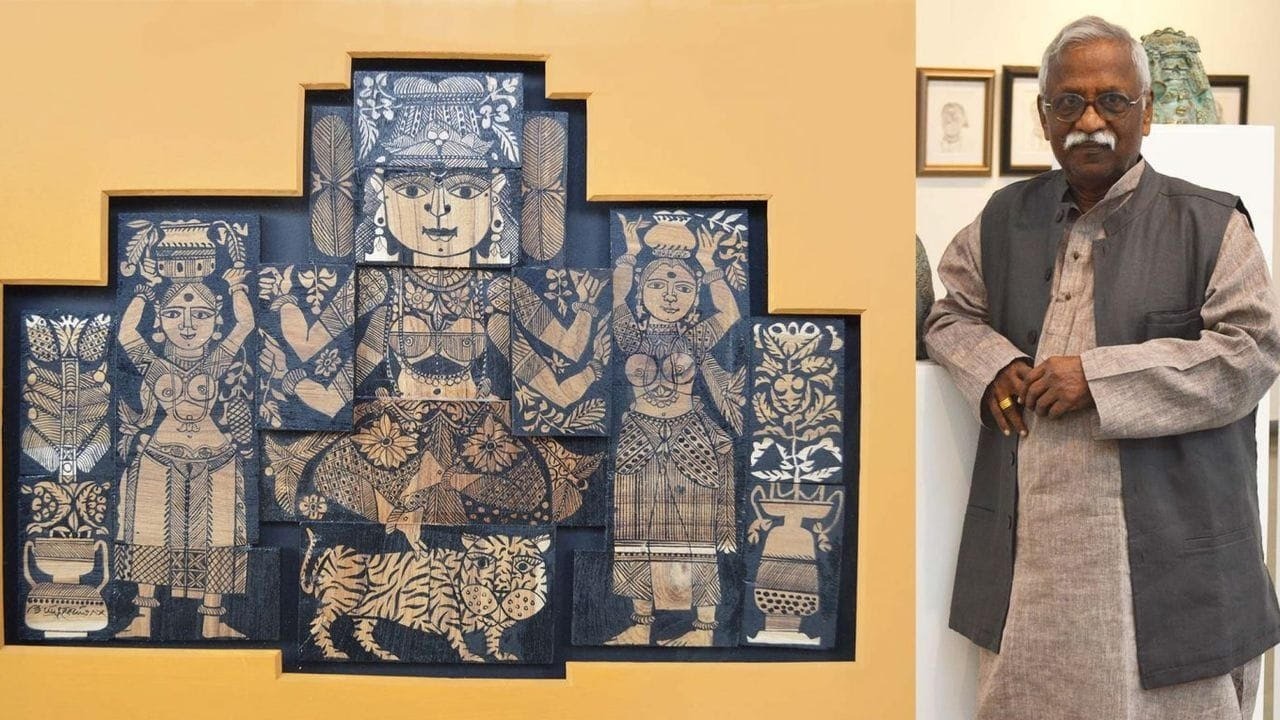
Laxma Goud is now one of the most admired names in Indian contemporary art, celebrated for his bold themes, mastery of many media and the way he shows rural Indian life with raw emotion plus sensuality. Over the past five decades, his works have shaped artistic discussions and attracted both experienced collectors but also new investors in the art market. His etchings watercolours, ink drawings and bronze sculptures each reflect a distinctive artistic voice giving Laxmā Goud a strong presence in museums as well as private collections.
The rise in collector interest is not accidental. Apart from their visual appeal, Goud’s paintings, prints and sculptures have become a reliable investment. Prices hold steady plus the work stays culturally relevant. Collectors want those pieces for clear reasons – those reasons reveal the solid demand that keeps the market active.
A Deep Emotional Connection With Rural India
One of the strongest reasons people seek Laxma Goud’s pictures is that he shows village India with plain truth. He was born in Nizampur, Telangana and spent his childhood watching the fields, the longings, the ties between neighbours and the fixed pulse of each day. Those memories stayed with him and now form the emotional ground under everything he draws.
Laxma Goud does not paint the village as an idyll. His people stand proud, sensual, open to hurt and they show a rural world that the usual pictures leave out. Collectors value that honesty – when they buy a Goud, they do not pay for a mere object, they keep a piece of cultural memory.
A Unique Blend of Sensuality and Identity
A clear trait that marks Goud’s work is the way he sets manliness against womanliness, links both to sensuality and asks who the self is. The bodies he paints swell far past real scale – yet they carry a raw emotional charge plus a tight pull of feeling. The face the stance, the eyes tell plain tales of yearning, closeness and power.
Although the sensuality in his works has provoked discussion, collectors treat that bold approach as proof of confidence and originality. The sensual elements are not extras added for drama – they belong to the way Goud reads human connection. For that reason his pictures carry a sharp emotional charge and that charge lifts both their appeal and their market value.
Mastery Across Multiple Mediums
Another factor in Laxma Goud’s market value is his exceptional versatility. Over his long career, he has worked with many different materials. including:
- Etching and printmaking
- Ink and pen drawing
- Watercolour and gouache
- Oil painting
- Bronze and terracotta sculptures
- Ceramics and mixed media
Collectors value artists who master more than one medium because such range points to an active mind, a readiness to adapt and plain technical ability. Goud does not change material merely to test boundaries – he chooses each medium with care so that it lets him convey feeling in a new way.
This diversity lets collectors pick from many categories and price points. New investors can enter the the market. High-value investors can enter the market.
Consistency in the Art Market
Market stability strongly influences collecting that aims at profit and the pictures of Laxma Goud have held their value. When they appear in private galleries, at auction or on the secondary market, their price rises steadily year after year. His prints first drew many new buyers toward art that keeps its worth, while his scarce bronzes and big canvases still fetch high prices.
Collectors also favour Goud because:
- He has a long and productive career
- His style is instantly recognizable
- His works have an established presence in institutional collections
- Market supply is limited, but demand remains constant
Auction results over the years show that more people now want his works, especially when they are cast bronze or large ink pieces. As collectors worldwide shift towards South Asian art, competition for Goud’s pieces is expected to grow.
Cultural Importance and Institutional Recognition
Institutional validation shows that a work will hold value for a long time in the art market. Laxma Goud has had solo and group shows in the main museums and galleries of India and he has shown in museums and galleries abroad. Public institutions like the National Gallery of Modern Art in Mumbai and the Lalit Kala Akademie in New Delhi own his work – private collectors in India and overseas own it as well.
His work appears in museums, biennales, academic texts and retrospectives – people stay aware of him even when the market cools. Curators and scholars favor artists whose stories shape cultural identity – Goud suits that role without effort. His pictures keep regional memory alive, hold layers of feeling and carry forward a living art tradition, therefore they hold worth for historians but also for buyers.
Appeal Across Generations of Collectors
A further reason for the sharp rise in demand for his work is that he speaks to many kinds of viewers. Collectors who have followed Indian art for decades respect him because he helped to form the course of contemporary art in India. Buyers who are new to the market praise him for the fresh outlook and the direct treatment of difficult subjects that run through his pictures. The feelings that lie beneath the surface, the ease with which he moves from one mood to another and the clear visual force of each canvas speak to people regardless of age or background.
His versatility also allows collectors to assemble whole portfolios that centre on one part of his output – either etchings or drawings or paintings or sculptures. This sharpens the profile of each collection. Many collectors treat Goud as a legacy artist whose importance will outlast the present generation.
Investment Outlook
The investment outlook for Laxma Goud is strong for several reasons:
- The artist’s cultural and artistic legacy continues to expand
- High demand and limited availability naturally elevate value
- Younger collectors and international buyers are entering the market
- Museums and institutions continue to celebrate his contribution
Collectors who buy his work today treat each piece as a cultural object and also as a financial asset. He paints sculpts, prints and films – buyers who plan ahead usually take one example of each kind in order to spread risk across their holdings.
Conclusion
Laxma Goud tells stories that stir feeling, stay true to his culture and try new forms. People prize his work for looks plus for lasting worth that holds value. A fine ink line a forceful etching or a solid bronze all draw love, regard and firm trade.
To view chosen groups of works by Laxma Goud but also other key living Indian artists, come now at ArtAliveGallery.